English (EUR)
 Česky (CZK)
 Deutsch (EUR)
 Austria (EUR)
 Polski (PLN)
 Français (EUR)
 Español (EUR)
 Italiano (EUR)
 Română (EUR)
 Ελληνικά (EUR)
 Dutch (EUR)
 Eesti keel (EUR)
 Português (EUR)
 Magyar (EUR)
 Svenska (EUR)
 Dansk (EUR)
 Suomen kieli (EUR)
 български език (EUR)
 Slovenščina (EUR)
 Slovensky (EUR)
 lietuvių kalba (EUR)
 latviešu valoda (EUR)
 Hrvatski (EUR)
 українська мова (EUR)
 Bahasa Indonesia (EUR)
What is 10-OH-HHC and what are its effects? Meet the new addition
- Information corner: What is 10-OH-HHC?
- Under the microscope: chemical structure and stereoisomers
- Zone of mild euphoria: How 10-OH-HHC works
- Souvenir stand: 10-OH-HHC products
- Conclusion
- FAQ
Information Corner: What is 10-OH-HHC?
10-OH-HHC or 10-hydroxyhexahydrocannabinol is a metabolite of HHC (hexahydrocannabinol). In the realm of cannabinoids, it is classified as a so-called hydroxylated derivative, similar to 8-OH-HHC. While 8-OH-HHC has its hydroxyl group (-OH) attached at the eighth carbon, 10-OH-HHC has it at the tenth position.
10-OH-HHC is a (semi)synthetic cannabinoid which has one extra hydroxyl functional group compared to HHC (the molecule is therefore a diol - consisting of 2 -OH groups) and thus the cannabinoid has slightly altered properties.
10-OH-HHC is produced naturally in the body as a metabolite of HHC - when HHC passes through the liver, enzymes from the cytochrome P450 family come into play to trigger the oxidation process. The result is a new compound: 10-hydroxy-HHC.
However, it is rarer in the plant itself than tiger albino 🐯 - it is only found in trace amounts, making it a minor cannabinoid.
The 10-OH-HHC compound was first synthesized and identified in 1980 by Professor Raphael Mechoulam's team.
In 2015, scientists at the University of Mississippi were able to isolate a pure form of 10-OH-HHC from the cannabis plant (Cannabis sativa).
Production of 10-OH-HHC
10-OH-HHC is usually produced (semi)synthetically in the laboratory by the controlled oxidation of HHC, which serves as a starting 🔬. The HHC itself is obtained by hydrogenation of natural THC or alternatively by synthesis from CBD extract from industrial hemp.
In the next step, a hydroxyl group (-OH) is attached to the tenth carbon of the HHC molecule to form 10-OH-HHC. The resulting substance takes the form of a white crystalline substance.
Some manufacturers claim that the hydroxyl group (-OH) increases the chemical stability and bioavailability of the molecule, i.e. that it is more easily absorbed and has a higher than HHC. However, at present these claims have not been independently verified and should therefore be taken with a grain of salt.
Under the microscope: chemical structure and stereoisomers
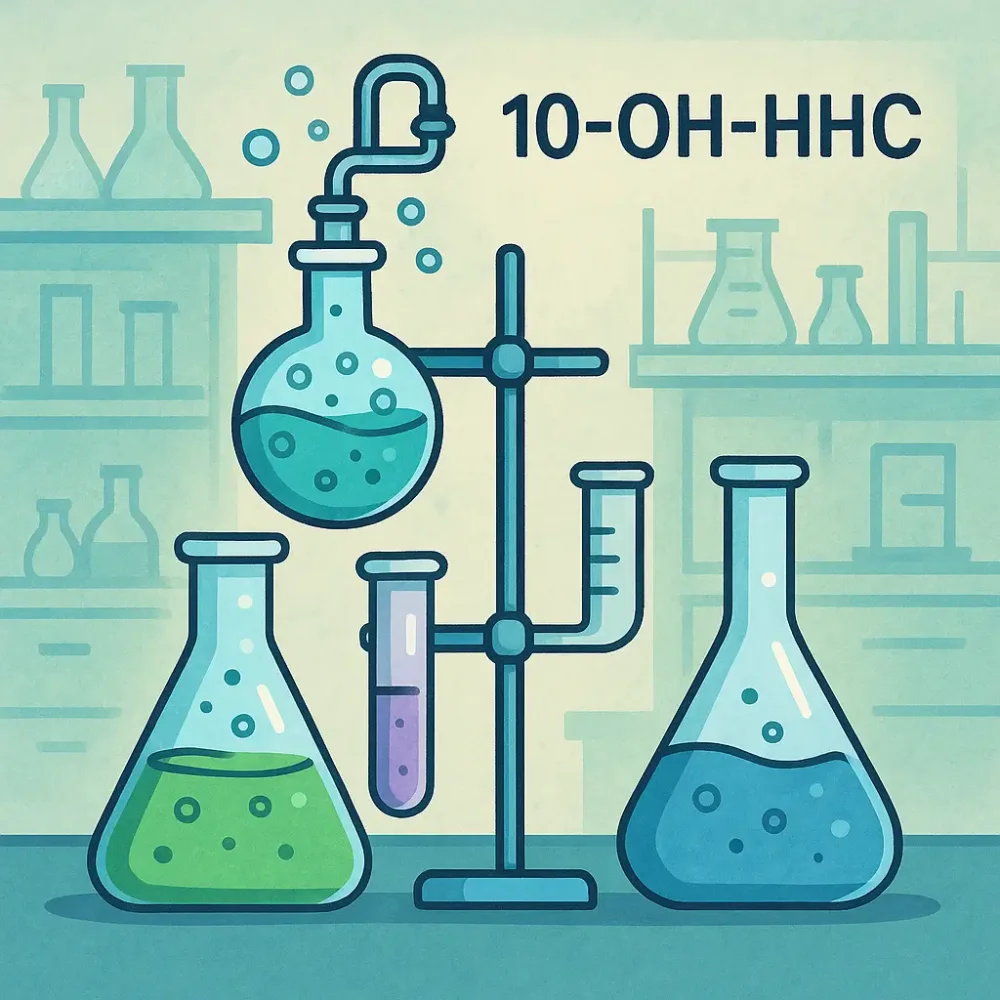
The molecular formula of 10-OH-HHC is C21H32O3, thus consisting of 21 carbon (C) atoms, 32 hydrogen (H) atoms and 3 oxygen (O) atoms.
The basic structure is based on HHC, which has the formula C21H32O2. Adding a hydroxyl group (-OH) to the 10th carbon replaces one hydrogen and adds one oxygen → the result is C21H32O3.
Like HHC and H4CBD, 10-OH-HHC has multiple "forms"- these are called stereoisomers. Stereoisomers differ from each other by the different arrangements of atoms around two particular carbons in the molecule.
In theory, there can be up to four, but in practice we most often talk about two 👇:
- 10(S),9(R)-10-OH-HHC - according to a study by Professor Mechoulam's team, this is the more "active" version, which in macaques produced a strong psychoactive effect at a low dose.
- 10(R),9(S)-10-OH-HHC - this version, on the other hand, is rather quiet, low-intensity or even non-psychoactive.
The representation of these molecules affects how effective the product will be.
The zone of mild euphoria: How 10-OH-HHC works
Although detailed pharmacological studies are still lacking, 10-OH-HHC is thought to act in a similar way to other psychoactive cannabinoids - i.e. as a partial agonist of the CB2 and CB1 cannabinoid receptors in the body (similar to THC). It is by binding to CB1 receptors in the central nervous system that it produces psychoactive effects.
Specific data on how 10-OH-HHC acts in the endocannabinoid system (ECS) are not yet available, but research in primates shows 🐒 that one of its isomers, specifically with the 10(S),9(R) configuration, produces significant psychoactive effects.
This suggests that 10-OH-HHC acts in a similar way to HHC and THC - i.e. via the ECS. This system is like an inner zoo, with each receptor having its own role: CB1 receptors are mainly found in the brain and affect mood, memory or appetite, while CB2 receptors are mainly found in immune cells and peripheral tissues.
Effects of 10-OH-HHC
10-OH-HHCis a psychoactive cannabinoid whose effects have been reported by users to be very similar to HHC. Scientific studies in humans are still lacking, but available reports and analogies with related substances suggest that it may induce 👇:
- Euphoria
- Changes in perception
- Elevated mood
- A feeling of relaxation
- Increased appetite

Information varies as to the intensity and strength of the effect. According to some sources, 10-OH-HHC has a slightly weaker psychoactive effect than HHC or THC - the effect is described as milder or less intense.
Differences may stem from differences in product quality, dose, route of administration and subjective tolerance. For example, with vaping the effect is almost immediate and wears off more quickly, whereas with gummies the effect takes 30-60 minutes, lasts longer and is more intense compared to vaping.
Users on online forums (e.g. Reddit) report that the effect of 10-OH-HHC is comparable to HHC, just perhaps lasting a slightly shorter time. The shorter duration of action may be related to the fact that hydroxyderivatives are broken down more quickly in the body.
The effect of 10-OH-HHC may occur more rapidly than that of HHC and may even take longer to wear off in some users, which is attributed to the better bioavailability of 10-OH-HHC.
Side effects
10-OH-HHC, like any psychoactive cannabinoid, can have its downside in the form of side effects. Their incidence and intensity depend on the dose, route of administration, sensitivity of each individual and the rate of metabolism.
The most common side effects include:
- Dry mouth (cotton mouth) 👅
- Red or dry eyes 👁️
- Drowsiness 💤 or conversely disturbed sleep 🦉
- Increased heart rate 💓
- Dizziness or slight disorientation 🌀
- Anxiety, nervousness or paranoia (at higher doses) 😵
- Heaviness of the body 🐘
- Impaired coordination and reaction time 🤸
- Impaired short-term memory and concentration 🧠❓
Symptoms such as dizziness, headache, paranoia, nausea can be caused mainly by overdose or combination with other substances (alcohol, other psychoactive substances or drugs) ❌ Never combine 10-OH-HHC with other psychoactive substances! ❌
🐾 Caregiver Tip: If you are trying 10-OH-HHC for the first time, start with a low dose and in a quiet environment where you feel safe. Everyone's reactions may be different - some will roll around like a panda 🐼, some will feel like a hyperactive lemur 🐒.
❌ Do not get behind the wheel or operate machinery after taking substances with psychoactive properties ❌. Even with subjectively weaker effects, perception and coordination may be affected.
Souvenir stand: 10-OH-HHC products
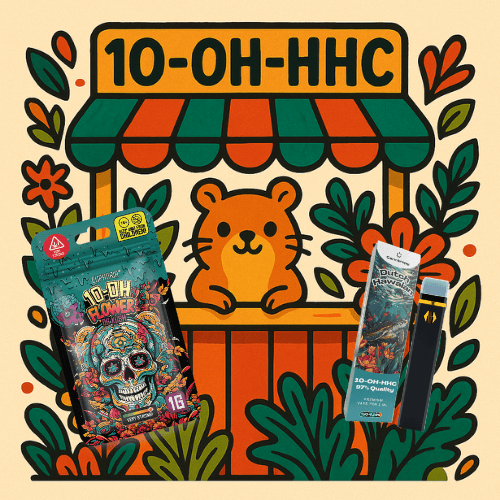
Among the fresh additions, 10-OH-HHC quickly found its place.
Explore what forms you can try 10-OH-HHC, and find your favourite 👇:
- 10-OH-HHC Vape pens: vaping pens you can start using right away. They are sold as disposable vaporizers (usually last about 200-600 puffs, some can be recharged) or reusable vaporizers (refillable with liquid or with replaceable cartridges).
- 10-OH-HHC Cartridge: pre-filled cartridges with 10-OH-HHC distillate in various concentrations and flavours, usually with natural terpenes, compatible with vaporizers and vaping batteries with 510 thread
- 10-OH-HHC Liquids: liquids for vaping
- 10-OH-HHC Flowers: sticks of technical cannabis infused with 10-OH-HHC distillate in various concentrations, strains and flavours
- 10-OH-HHC Prerolls: pre-packaged joints containing 10-OH-HHC flowers
- 10-OH-HHC Oils and Drops: made by mixing 10-OH-HHC extract with a carrier oil such as MCT oil, hemp oil, sunflower oil, etc.
- 10-OH-HHC Gummies: a sweet form with a precisely measured dose of 10-OH-HHC.
- 10-OH-HHC Sweets: various snacks containing 10-OH-HHC, similar to gummies.
Conclusion
10-OH-HHC represents one of the most recent additions to the family of (semi)synthetic cannabinoids that have appeared on the market as alternatives to HHC and THC. It is a metabolite of HHC and is classified as a hydroxyderivative. It is usually obtained in a laboratory environment - by controlled oxidation of HHC 🔬.
Research is just beginning to take off and most of the findings come from field notes from users who describe that 10-OH-HHC can induce euphoria, physical relaxation, changes in perception and increased appetite.
Since more detailed data is still lacking, the rule of any good caregiver is: approach with respect 🐾 and watch reactions carefully.
FAQ
1. What is the difference between 10-OH-HHC and HHC?
10-OH-HHC is a metabolite of HHC - it is produced when it breaks down in the body, possibly by oxidation in the lab. It has an extra hydroxyl group (-OH), which may make it more easily absorbed, but it usually acts a little more gently than HHC.
2. What is the difference between 10-OH-HHC and 8-OH-HHC?
Both of these cannabinoids are formed from HHC, but differ in the location of the hydroxyl group - 8-OH-HHC has it on the eighth carbon, while 10-OH-HHC has it on the tenth carbon.
3. Is 10-OH-HHC psychoactive?
Yes. It acts on CB1 and CB2 receptors in a similar way to HHC or THC. It can induce euphoria, relaxation, altered perception and increased appetite. Users describe the effect as physical (body high) and rather calm.
4. Will 10-OH-HHC show up in a drug test?
Standard tests detect THC and its metabolites, not hydroxyderivatives. However, even in the absence of specific data, there is a risk of false positive results, especially for tests sensitive to related THC compounds.
5. Is 10-OH-HHC legal in the European Union?
Yes, 10-OH-HHC products are currently considered legal in the EU if they contain less than 0.2% THC and are not on the list of banned substances. However, legislation can vary from country to country, so always check 🌍.
6. Is 10-OH-HHC suitable for beginners?
If you're new to the world of cannabinoids, you're better off reaching for cannabinoids like CBD, CBG, and CBN first. If you're tempted to visit the New Cannabinoids Pavilion, you can try H4CBD, THCV or CBG9 to get started.
10-OH-HHC is good for users who already know their way around the cannabis paddock a bit.
Resources:
- jcannabisresearch.biomedcentral.com/articles/10.1186/s42238-024-00226-y
- pubs.acs.org/doi/abs/10.1021/jm00184a002
- caymanchem.com
- reddit.com
- reddit.com/r/HHC_legends/comments/1jixa92/help_finding_10ohhhc
- reddit.com/r/hhcvapes/comments/1fttzkb/10ohhhc_vapecatridge
- pmc.ncbi.nlm.nih.gov
Author: Patrície Mikolášová
Photo: AI
"All information provided on this website, as well as information provided through this website, is for educational purposes only. None of the information contained herein is intended to be a substitute for a medical diagnosis and should not be considered medical advice or recommended treatment. This website does not endorse, condones or advocate the licit or illicit use of narcotic drugs or psychotropic substances or the commission of any other illegal activity. For more information, please see our Disclaimer."
Recommended products5
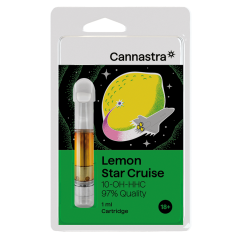
Cannastra 10-OH-HHC Cartridge Lemon Star Cruise, 10-OH-HHC 97% quality, 1 ml
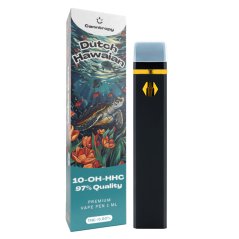
Canntropy 10-OH-HHC Vape Pen Dutch Hawaian, 10-OH-HHC 97% quality, 1 ml
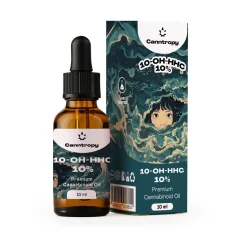
Canntropy 10-OH-HHC Premium Cannabinoid Oil, 10 % 10-OH-HHC, 10ml
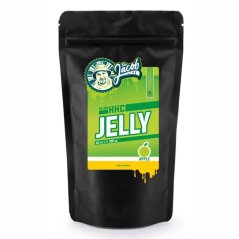
Czech CBD 10-OH-HHC Jelly Green apple, 10 pcs x 20 mg, 200 mg 10-OH-HHC