English (EUR)
 Česky (CZK)
 Deutsch (EUR)
 Austria (EUR)
 Polski (PLN)
 Français (EUR)
 Español (EUR)
 Italiano (EUR)
 Română (EUR)
 Ελληνικά (EUR)
 Dutch (EUR)
 Eesti keel (EUR)
 Português (EUR)
 Magyar (EUR)
 Svenska (EUR)
 Dansk (EUR)
 Suomen kieli (EUR)
 български език (EUR)
 Slovenščina (EUR)
 Slovensky (EUR)
 lietuvių kalba (EUR)
 latviešu valoda (EUR)
 Hrvatski (EUR)
 українська мова (EUR)
 Bahasa Indonesia (EUR)
New resident of Cannabizoo: What is 8-OH-HHC and what are its effects?
- In the open range: What is 8-OH-HHC?
- Biochemistry Pavilion: How is 8-OH-HHC formed?
- 8-OH-HHC under a microscope
- Observation Room: What are the effects of 8-OH-HHC?
- With sharp claws: Side effects
- Newsstand: Which 8-OH-HHC products should you try?
- Conclusion
- FAQ
In the free range: What is 8-OH-HHC?
In the cannabis zoo, there are sometimes species that keep to themselves but play a very important role. One of these is 8-OH-HHC (8-hydroxyhexahydrocannabinol), which is produced as a primary metabolite during the processing of HHC (hexahydrocannabinol).
8-OH-HHC belongs to a pack🐺🐺 of chemical derivatives, where you will also find its siblings 8-OH-9α-HHC and 8-OH-9β-HHC. What connects them? A unique chemical structure that gives them properties that ordinary inhabitants of cannabis enclosures lack.
You'll usually only catch a glimpse of 8-OH-HHC out of the corner of your eye, like a rare Przewalski's horse 🐎 darting across the steppe. This is because it only appears in trace amounts in the hemp plant itself and is classified as a trace phytocannabinoid.
Biochemical pavilion: How is 8-OH-HHC formed?
When HHC enters the body (e.g., after vaporization), natural biochemical processes are triggered. Enzymes from the cytochrome P450 family, specifically CYP3A4, CYP2C9, and CYP2C19, act as invisible guardians.
These enzymatic beasts 🐅 can add an oxygen atom to the HHC molecule and transform it into a new compound: 8-OH-HHC.
A similar conversion process 🐛🦋 is no exception in the cannabinoid realm. Other well-known species, such as delta-9-THC (tetrahydrocannabinol, THC), delta-8-THC, and 10-OH-HHC, are converted in the body in the same way.
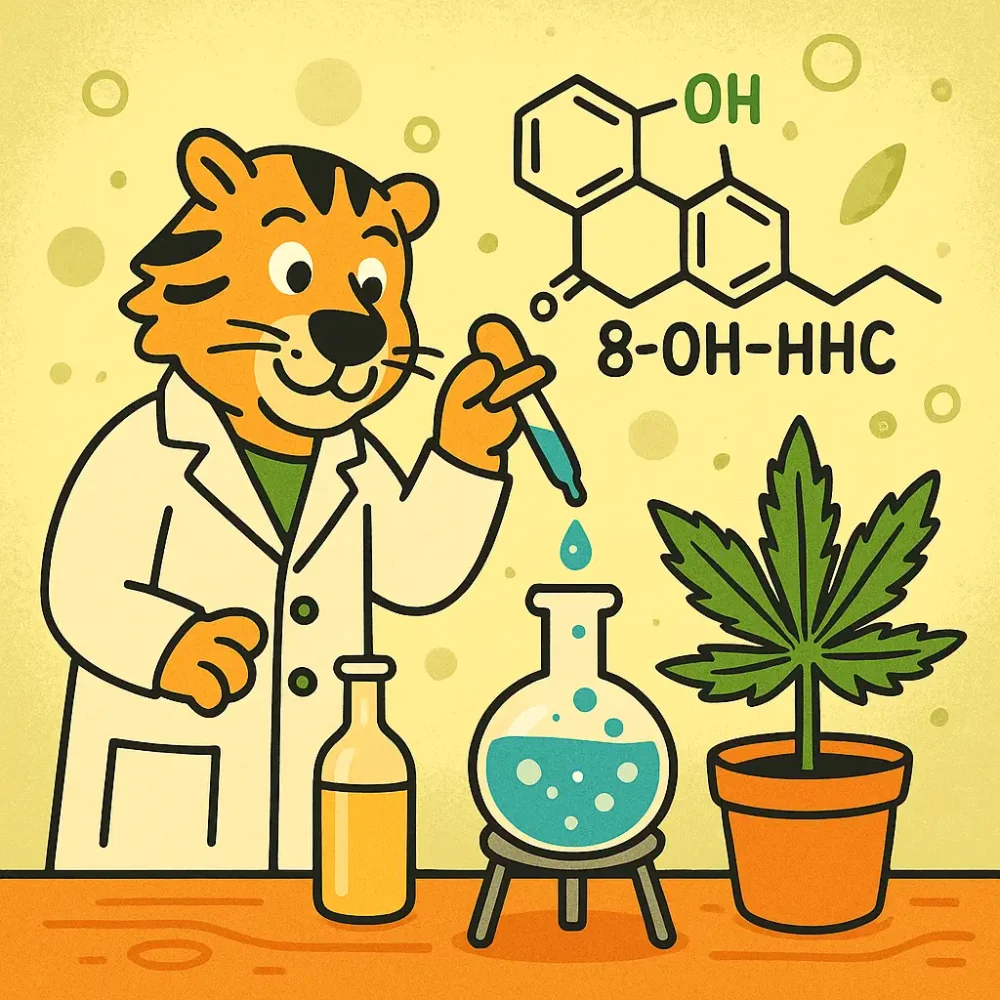
And how is 8-OH-HHC produced commercially?
Scientists create this cannabinoid in the laboratory by synthesizing it from HHC. The key step is hydroxylation, or the addition of a hydroxyl group (–OH) to a specific location in the molecule. In 8-OH-HHC, this is the eighth carbon of the hexahydrocannabinol core, and in 10-OH-HHC, it is the tenth.
Either enzymes or chemical catalysts are used for this process. And because molecular shapes can be arranged in different ways, different stereoisomers are created – as if each zebra in a herd had a slightly different stripe pattern. 🦓
In 8-OH-HHC, for example, you will encounter the aforementioned forms 8-OH-9α-HHC and 8-OH-9β-HHC. The synthesis method chosen influences which of these isomers will ultimately appear in the product.
8-OH-HHC under a microscope
If you look closely at 8-OH-HHC, you will find that it is not just one creature, but several.
The formula C₂₁H₃₂O₃ hides four variants:
- cis-8-OH-9α-HHC
- trans-8-OH-9α-HHC
- cis-8-OH-9β-HHC
- trans-8-OH-9β-HHC
These stereoisomers differ in the arrangement of their atoms, which scientists noticed as early as the 1980s. They therefore began to investigate how these differences affect the "behavior" of the individual forms (i.e., their biological activity).
In 1991, legendary chemist Raphael Mechoulam joined the research. He and his team conducted in vivo tests on rhesus monkeys 🐒 and found that the most active form is cis-8-OH-9β-HHC – think of it as the alpha male of the pack. But other stereoisomers also have their advantages and affect the body in their own way.
The animal kingdom is diverse, and this is doubly true in the cannabinoid world. The study also showed that mice 🐭 naturally produce a different form of 8-OH-HHC than hamsters. 🐹
Observation: What are the effects of 8-OH-HHC?
8-OH-HHC is psychoactive, so get ready for a little zoo train ride.
You can expect, for example:
- a slight change in perception
- a pinch of euphoria
- a rush of relaxation
- hunger like a lion 🦁
Compared to HHC or THC, however, it is more of a quiet observer 🦉 than a king of the flock – because it is a hydroxy derivative, its effects tend to be milder and fade faster.
Like other cannabinoids, 8-OH-HHC likely binds to CB1 and CB2 receptors in the endocannabinoid system (ECS) of the human body. The ECS plays a key role in regulating a range of bodily functions, such as mood, immunity, sleep, and pain perception.
Research on 8-OH-HHC is still in its early stages, so we will have to wait a while longer to learn more about its exact effects and links to the ECS.
With sharp claws: Side effects
⚠️Experience with other psychoactive cannabinoids (e.g., HHC, HHCP, or THCP) suggests that the following adverse reactions may occur when using 8-OH-HHC:
- Dry mouth
- Red and dry eyes
- Drowsiness or insomnia
- Increased heart rate
- Anxiety and paranoia
- Dizziness
Their occurrence depends on the dosage, method of use, metabolism, or overall health of each Cannabizoo visitor. Reactions are highly individual, so we recommend proceeding with caution and closely monitoring your own experience. 🐾
Newsstand: Which 8-OH-HHC products should you try?
Among the fresh additions to the cannabinoid pavilion, 8-OH-HHC has a firm place. It adapts to your rhythm and mood like a well-trained Cannabizoo resident. 🦭
See what forms you can enjoy its effects in and choose your favorite:
- 8-OH-HHC Vapes: A convenient and quick solution – disposable pens or refillable vaporizers allow for inhalation with a rapid onset of effects.
- 8-OH-HHC Liquids: Vaping liquids with a variety of flavors. 🦜
- Cartridges: Pre-filled cartridges with 8-OH-HHC just need to be connected to a compatible battery or vaporizer.
- 8-OH-HHC Hash: A concentrated form of 8-OH-HHC that you can enjoy by vaporizing with a classic vaporizer or dab rig.
- Prerolls: Pre-rolled joints with 8-OH-HHC flowers.
- 8-OH-HHC Flowers: Technical hemp infused with 8-OH-HHC distillate and supplemented with terpenes for an authentic experience.
- Oils: A combination of 8-OH-HHC and MCT coconut oil – suitable for sublingual application under the tongue or mixing into food. The onset of effects is slower 🦥, but they last longer.
- Gummies: Fruit candies with a precisely measured dose of 8-OH-HHC.
🎒 Caregiver tip: If you are new to 8-OH-HHC, start with a smaller dose and ideally a form that you can control better (e.g., oil).
All products contain less than 0.2% THC and are therefore compliant with current European Union legislation.
After using 8-OH-HHC and other similar substances, it is not recommended to drive or operate any machinery.
Conclusion
8-OH-HHC (8-hydroxyhexahydrocannabinol) occurs naturally as a metabolite during the processing of HHC in the body, or synthetically in the laboratory by hydroxylation of the HHC molecule. Despite its low presence in the cannabis plant, it is gaining attention due to its mild psychoactive effects and the possibility of offering a different experience than THC or HHC. It is mainly used through vaporization, oils, gummies, flowers, or cartridges.
If you are looking for an alternative to classic cannabinoids, 8-OH-HHC may be an interesting choice.
FAQ
1. What is the best way to use 8-OH-HHC?
For a quick onset of effects, vapes or cartridges are ideal. If you want a more natural experience, try flowers or hash – they also offer a flavor profile thanks to added terpenes. Oils and gummies are suitable for precise dosing and longer effects, although they take longer to kick in.
2. Can I combine 8-OH-HHC with other cannabinoids?
In practice, 8-OH-HHC is sometimes combined with CBD for a more balanced effect. However, each organism reacts individually, so it is advisable to start with a lower dose and monitor how your body reacts to the combination of substances.
3. How quickly do the effects of 8-OH-HHC kick in and how long do they last?
The effects are generally milder and shorter than those of HHC or THC. When inhaled (vaped), they kick in within a few minutes and usually wear off within 1–2 hours. When ingested (gummies), the onset may take longer, but the effects can last for 4–6 hours.
4. Is 8-OH-HHC detectable in drug tests?
Although 8-OH-HHC is a metabolite of HHC, it is not yet clear whether common THC tests react to it. However, some types of tests may detect related compounds, so caution is advised.
5. Is 8-OH-HHC legal in the European Union?
Products containing 8-OH-HHC are legal in the EU if they contain less than 0.2% THC and are not on the list of prohibited substances. However, laws vary from state to state, so it is always a good idea to check the current legislation.
6. How does 8-OH-HHC differ from 10-OH-HHC?
Both are derived from HHC, but they differ in their chemical structure. 10-OH-HHC may have slightly stronger effects, while 8-OH-HHC tends to be milder and has a shorter duration. Research into the differences is still in its early stages.
Sources:
- ACS Publications
- Science Direct
Author: Pavla Skřivánková
Photo: AI
"All information provided on this website, as well as information provided through this website, is for educational purposes only. None of the information contained herein is intended to be a substitute for a medical diagnosis and should not be considered medical advice or recommended treatment. This website does not endorse, condones or advocate the licit or illicit use of narcotic drugs or psychotropic substances or the commission of any other illegal activity. For more information, please see our Disclaimer."
Recommended products3
Canntropy 8-OH-HHC Premium Cannabinoid Oil, 10 % 8-OH-HHC, 10ml
Canntropy 8-OH-HHC Vape Pen Galactic Gas, 8-OH-HHC 90% quality, 1ml