English (EUR)
 Česky (CZK)
 Deutsch (EUR)
 Austria (EUR)
 Polski (PLN)
 Français (EUR)
 Español (EUR)
 Italiano (EUR)
 Română (EUR)
 Ελληνικά (EUR)
 Dutch (EUR)
 Eesti keel (EUR)
 Português (EUR)
 Magyar (EUR)
 Svenska (EUR)
 Dansk (EUR)
 Suomen kieli (EUR)
 български език (EUR)
 Slovenščina (EUR)
 Slovensky (EUR)
 lietuvių kalba (EUR)
 latviešu valoda (EUR)
 Hrvatski (EUR)
 українська мова (EUR)
 Bahasa Indonesia (EUR)
Discover Kava Kava, the Pacific symbol of relaxation and euphoria
What is Kava Kava?
Kava Kava, also known as pepper tree, is a shrub that grows up to 6 meters tall with heart-shaped leaves. Like the leatherback turtle 🐢 or the red kangaroo 🦘, the pepper tree originates from the Pacific region.
Its root is particularly prized for its exceptional properties, which have made it popular with indigenous tribes for centuries. The natives traditionally crush it and mix it with water or coconut milk. This elixir is said to relax the body and mind, induce euphoria, and relieve pain. In the Pacific, it has been used since ancient times for religious rituals and in traditional medicine.

Kava Kava arrived in Europe in the 18th century, when it was brought back from his travels by the navigator James Cook. It was first described in the same century by father and son Forest. However, interest in it is only now growing, partly because it is more accessible, but also thanks to the increasing popularity of alternative medicine.
What can Kava Kava do?
Kava Kava is a symbol of complete relaxation. It should also induce a feeling of intoxication and reduce pain. These effects are caused by kavalactones—psychoactive compounds that make up to 20% of the root! After consumption, these substances get to work like busy bees 🐝, affecting several systems in the human body:
- GABAA receptors: the main inhibitory receptors of the central nervous system.
- Happiness hormone receptors: affect the production of serotonin and dopamine.
- Opioid receptors: regulate the perception of reward and pain.
Through these receptors, kavalactones can slow down nerve cell activity, increase the production of happiness hormones, induce feelings of bliss and relieve pain, reduce anxiety and stress, and promote sleep.
The effects usually set in within 10 minutes and are fully apparent within 45 minutes. The euphoria lasts for about 1 to 3 hours and the relaxation for up to 36 hours.
Previous studies show that over 70% of people who were given 300 mg of kava kava extract daily experienced a significant decrease in anxiety after just 1 week of use, and the improvement continued over the next 24 weeks.
Kava kava has a positive effect on stress-related insomnia. Subjective assessments by test subjects show that stress reduction and fewer sleep disturbances occurred after 6 weeks of administration.
Research does not suggest that Kava Kava is addictive. However, this does not mean that it is completely risk-free. The following may occur:
- drowsiness
- nausea
- dizziness
- vivid dreams
With long-term use, the following may occur:
- increased hand tremors
- dry and yellowish skin
- liver damage
Kava Kava is not suitable for pregnant and breastfeeding women and should not be combined with alcohol and caffeine.
Where can you find Kava Kava?
Although Kava Kava has been known for many years, it has not received sufficient attention, and therefore there are not many products containing Kava Kava on the market. It should be approached with caution, just like an unknown animal species🐆. Kava kava products are not intended for direct consumption, but only for collection purposes.
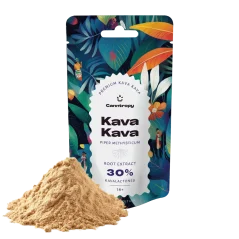
The root of the pepper tree is usually dried and ground into a fine brown powder. This extract is available separately or as part of other products such as capsules or liquids for vapes.
Conclusion
Popular with Pacific shamans, Kava Kava is said to relieve anxiety and stress, relax the mind and body, induce a good mood, and relieve pain without causing addiction. This is due to psychoactive compounds called kavalactones, which make up up to a fifth of this miraculous root.
However, it also has potential dangers. In addition to being intoxicating, it can cause drowsiness, nausea, dizziness, or vivid dreams. With long-term use, hand tremors, dry and yellowish skin, and liver damage may occur.
FAQ
1. Is Kava Kava legal?
Kava kava is not regulated and is legal in most countries.
2. Could Kava Kava serve as a natural alternative to anxiety medications (benzodiazepines)?
Studies suggest that kava kava can significantly reduce anxiety and stress without causing addiction, but the research to date is insufficient. Kava Kava is therefore not recognized as a safe medicine and certainly cannot replace treatment recommended by a doctor.
3. Does Kava Kava cause intoxication like alcohol?
Not quite. Kava Kava can induce feelings of relaxation and euphoria, but it should not cause loss of coordination or nausea.
4. Is Kava Kava an opioid?
No. Kavalactones, the active ingredients in Kava Kava, are chemically not derived from opium or synthetic analogues. Although they also partially act on opioid receptors, they do not bind to them fully and primarily affect GABAA receptors.
5. Will Kava Kava show up in drug tests?
Standard drug tests will not detect Kava Kava because they are not designed to identify kavalactones.
Author: Natálie Kubíčková
Photo: AI
"All information provided on this website, as well as information provided through this website, is for educational purposes only. None of the information contained herein is intended to be a substitute for a medical diagnosis and should not be considered medical advice or recommended treatment. This website does not endorse, condones or advocate the licit or illicit use of narcotic drugs or psychotropic substances or the commission of any other illegal activity. For more information, please see our Disclaimer."
Recommended products2

Hemnia Deep Relaxation - Cartridge, 5 % CBDP, 90 % CBN, kava kava, valerian, lemon balm, 1 ml