English (EUR)
 Česky (CZK)
 Deutsch (EUR)
 Austria (EUR)
 Polski (PLN)
 Français (EUR)
 Español (EUR)
 Italiano (EUR)
 Română (EUR)
 Ελληνικά (EUR)
 Dutch (EUR)
 Eesti keel (EUR)
 Português (EUR)
 Magyar (EUR)
 Svenska (EUR)
 Dansk (EUR)
 Suomen kieli (EUR)
 български език (EUR)
 Slovenščina (EUR)
 Slovensky (EUR)
 lietuvių kalba (EUR)
 latviešu valoda (EUR)
 Hrvatski (EUR)
 українська мова (EUR)
 Bahasa Indonesia (EUR)
Discover Kanna (Sceletium tortuosum), the "happy plant" from the African savannah
- Information corner: What is kanna? Appearance, occurrence and history
- Relaxation zone: How does kanna work and what are its effects?
- Science corner: A brief summary of studies and research
- Risks and possible side effects
- Botanical collection: Kanna in various forms
- Conclusion
- FAQ
Disclaimer: The information in this article is for ethnobotanical, historical and educational purposes only. Kanna products offered at CannabiZoo are intended for collection, decorative or botanical purposes only. They are not intended for consumption, inhalation or other use.
Information corner: What is kanna? Appearance, occurrence and history
Kanna (Sceletium tortuosum) is a plant from southern Africa that has earned its place among the most interesting botanical treasures. It looks like a common succulent that is easy to overlook, as it is a low herb with fleshy leaves and small white or yellow flowers.
It grows mainly in southern Africa 🌍, in what is now South Africa, where it thrives among rocks, sand and dry winds. Where other plants would give up, kanna grows without any problems, thanks to its fleshy leaves that can retain water, allowing it to survive even long periods of drought. From the African plains, its cultivation has spread further into the world.

Kanna stays close to the ground, usually growing to only about 30 centimetres. It forms dense green cushions that look almost like carpets of tranquillity among the rocks. People discovered the power of kanna hundreds of years ago.
Indigenous tribes (the Khoisan, i.e. the San and Khoikhoi) used it when they wanted to calm their minds, improve their mood or simply tune into a wave of well-being.
The natives called it kougoed ("chewing goodie"). When the plant was left to ferment for several days, it lost its natural bitterness and became not only tastier, but also more effective and easier to absorb. According to tradition, people chewed, smoked, sniffed or made tea from khanna.
Nowadays, kanna is not only referred to as a "natural antidepressant", but also as a plant that helps to manage stress, relax the body and find mental balance.
Relaxation zone: How does kanna work and what are its effects?
Kanna contains substances that affect the serotonin system, specifically alkaloids such as mesembrine, mesembrene and tortuosamine. Serotonin (the happiness hormone) affects mood, emotions and inner peace.
Simply put, the alkaloids in kanna help keep more serotonin in the brain, so you can feel calmer, be in a better mood and feel less tense. It works similarly to modern antidepressants, but without the side effects commonly associated with them.
In addition, scientists have found that kanna also affects the PDE4 enzyme, which is involved in how the brain copes with stress. When its activity is reduced, nerve cells "communicate" better with each other, so a person may feel more balanced and focused.
ℹ️ Kanna is also known as the "happy plant" or "natural Prozac from Africa".
Possible effects of kanna
Published studies and expert observations suggest that kanna may provide relief from stress, anxiety and mild forms of depression. Some sources suggest that it promotes openness, communication and libido.
Other interesting potential effects of kanna:
- Relief of pain and inflammation symptoms 🦷
Kanna has traditionally been used for toothache, stomach ache and cramps. Current research suggests that the alkaloids it contains also act on pain receptors (it has a mild analgesic and anti-inflammatory effect).
- Antioxidant and natural shield 🛡️
Laboratory studies have also demonstrated its antioxidant and antimicrobial properties (protecting cells from stress and microbes). These effects are still being studied in humans, but the initial results are promising.
- Evening relaxation and better sleep 💤
Many people report that it helps them sleep better and contributes to calming the mind, especially when taken in the evening. It can release tension, calm the mind and promote overall relaxation.
According to some sources, kanna may also act as a mild nootropic, i.e. an herb that promotes concentration and mental clarity. Scientists attribute this to its natural effect on stress and brain chemistry.
Although the results look promising, scientists point out that more extensive clinical trials are needed 📚. But it is already clear that kanna is not a placebo. On the contrary, it has measurable bioactive effects, whether on mood, stress or quality of rest.
Science corner: A brief summary of studies and research
🔎 Clinical trials with standardised kanna extract show that it is well tolerated and safe at low doses (for 3 months at doses of 8 and 25 mg per day).
🔎 Imaging studies (fMRI) suggest rapid calming of stress circuits in the brain – people are better able to cope with anxiety-inducing stimuli.
🔎 A general overview mentions a dual mechanism (serotonin support + PDE4 influence) that may contribute to improved mood and stress resistance.
🔎 A systematic review from 2023 summarises promising effects on anxiety, albeit with a smaller number of studies/participants.

Risks and possible side effects
Kanna is generally considered safe and well tolerated when not taken in large doses.
Possible side effects include:
- headache
- nausea
- drowsiness
- indigestion
These symptoms are usually mild and go away on their own.
🚨 Caution when combining with other medications: Kanna can affect the serotonin system and therefore should not be mixed with SSRI or MAOI antidepressants or supplements containing 5-HTP.
🚨 Experts also warn of the risk of overdose: high doses or snorting extracts can cause serotonin overload, known as serotonin syndrome.
Botanical collection: Kanna in various forms
Kanna exists in several forms, from dried herbs to potent extracts. Each of these forms has a slightly different character.

- Kanna flower (dried herb)
- It consists of dried and fermented parts of the plant, a mixture of leaves, stems and flowers, or kougoed. It has a subtle herbal aroma and a natural, gradual effect. It is traditionally used to make tea or for chewing.
- Kanna powder
- This is ground fermented kanna. The colour varies depending on fermentation, from light to dark brown. The effect is usually mild and slow-onset, similar to the herb itself. The strength may vary depending on quality and batch. A practical and popular form among collectors.
- Kanna extract
🐾 In most EU countries, kanna is not listed as a controlled substance. It can therefore be freely sold as botanical/collectible material, but is not intended for consumption.
Conclusion
Kanna undoubtedly belongs in the pavilion of tranquillity, somewhere between sloths 🦥 and pandas 🐼. It is inconspicuous, but it has an inner strength that can calm restless thoughts and improve your mood even after a busy day.
For centuries, it has been bringing people peace, a better mood and stress relief. Although science is still gathering more knowledge, current research and experience suggest that kanna is not just a fashion trend, but a plant with real potential that is worth further exploration.
FAQ
1. What does kanna extract 20:1 and 100:1 mean?
The ratio expresses how much dried plant was used to produce 1 g of extract.
- Kanna 20:1 → 20 g of plant = 1 g of extract.
- Kanna 100:1 → 100 g of plant = 1 g of extract.
The higher the number, the stronger the concentration.
2. Is there a recommended dosage for kanna?
No. There is no official dosage standard because studies are small and use different forms of the product.
Kanna can affect everyone differently; some people will feel calm like a sloth 🦥, while others will become restless like a caged tiger 🐯.
Experts also say that it is better to start with as little as possible and wait to see how your body reacts.
3. What experiences with kanna do people share on the internet?
📣 On Erowid, one user reported that he measured out approximately 500 mg of the herb and brewed it into tea. About halfway through the cup of tea (he drank it relatively slowly), he began to feel relaxed and joyful. After finishing the tea, he had a very pleasant feeling, especially in his arms and legs. He smiled a lot and felt energetic and sociable. He said he was not euphoric, but he was in a very good mood. After about 45 minutes, the energy faded, and he remained in a positive mood for another 1.5 hours.
📣 On the DMT-Nexus forum, one user wrote: "When I chew about 1 g of khat, I feel a gentle serotonin 'rush', slight euphoria, openness – and even music sounds better to me. When I tried 1.5 g, the effect was stronger, but I also experienced mild stomach discomfort. And when I combined it with cannabis, the experience was almost psychedelic. But at doses of 3–4 g, I felt very nauseous."
📣 Another user on drugscouts reported feeling a strong physical charge when using a higher concentration: intense sweating, confusion, heat, the body "struggling" before the effect stabilised. Later, however, he felt clear-headed, focused, relaxed and confident.
📣 On the Shroomery forum, a user shared their experience with "pharmaceutical-grade" powdered kanna and wrote that they experienced a really intense burning sensation after snorting a 50 mg dose. This triggered a rapid and powerful adrenaline rush, the intensity of which completely overshadowed the kanna. In conclusion, they stated: "I will never snort powder from canna leaves of any quality again."
The following experiences show that the method of use (oral, sublingual, nasal) affects the intensity of the effect, with most negative experiences related to more aggressive administration (snorting) or too high a dose.
ℹ️ Online reports can give an idea of subjective experiences, but they are no substitute for scientific evidence of efficacy and risks.
4. Kanna vs. kratom: Which is better?
It is impossible to say unequivocally which plant is "better" because each has a different effect and it depends on what a person expects from it.
Kanna and kratom have completely different characteristics and affect different parts of the nervous system.
- Kanna (Sceletium tortuosum)
- It comes from South Africa and affects serotonin, the "happiness hormone". It helps calm the mind, improve mood and reduce stress. The effect is gentle, mental and non-addictive. Kanna tunes a person in rather than "turning them off".
- Kratom (Mitragyna speciosa)
- It grows in Southeast Asia and acts on opioid receptors (which respond to pain and fatigue). In small doses, it stimulates, while in higher doses, it relaxes and relieves pain. It can be very powerful and, with frequent use, can lead to tolerance and dependence.
5. Who should not use kanna?
Although kanna is natural, it is not suitable for everyone ❌. It is not recommended for certain people, mainly:
- Pregnant and breastfeeding women
- Children and adolescents
- People with mental illnesses (e.g. bipolar disorder, schizophrenia)
- People with high blood pressure or heart problems
- People with liver or kidney disorders
ℹ️ It is always best to consult your doctor beforehand, especially if you are taking medication or have health problems.
Sources:
- verywellmind.com/news-is-kanna-really-natures-mdma-heres-what-you-need-to-know-5425954
- kanna-info.com/history-of-kanna
- researchgate.net
- researchgate.net/publication/281664094_Natural_products_of_relevance_in_the_prevention_and_supportive_treatment_of_depression
- researchgate.net/publication/235739029_A_Randomized_Double-Blind_Parallel-Group_Placebo-Controlled_Trial_of_Extract_Sceletium_tortuosum_Zembrin_in_Healthy_Adults
- sciencedirect.com
- sciencedirect.com/science/article/abs/pii/0378874195013423
- sciencedirect.com/science/article/pii/S266645932300029X
- sciencedirect.com/science/article/abs/pii/S0031942219301438
- sciencedirect.com/science/article/abs/pii/S0378874121007054
- onlinelibrary.wiley.com
- nature.com/articles/npp2013183
- europepmc.org/article/MED/23441963
- medcraveonline.com/IJCAM/exploring-standardized-zembrinreg-extracts-from-the-south-african-plant-sceletium-tortuosum-in-dual-targeting-phosphodiesterase-4-pde-4-and-serotonin-reuptake-inhibition-as-potential-treatment-in-schizophrenia
- mdpi.com/1420-3049/26/9/2557
- ndnr.com/botanical-medicine/sceletium-tortuosum-mood-stress-support
- drugs.com/npp/sceletium-tortuosum
- forum.dmt-nexus.me/threads/my-experience-of-kanna-scleletium-tortuosum
- shroomery.org/forums/showflat.php/Number/6767511
- erowid.org/experiences/exp.php?ID=107306
- drugscouts.de/news/aktueller-kanna-erfahrungsbericht
Author: Patricie Mikolášová
Photo: AI
“All information provided on this website, as well as information provided through this website, is for educational purposes only. None of the information contained herein is intended to be a substitute for a medical diagnosis and should not be considered medical advice or recommended treatment. This website does not endorse, condones or advocate the licit or illicit use of narcotic drugs or psychotropic substances or the commission of any other illegal activity. For more information, please see our Disclaimer .”
Recommended products4
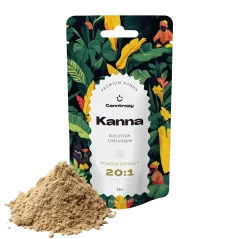
Canntropy Kanna (Sceletium Tortuosum) Powder Extract 20x, 1 g - 100 g
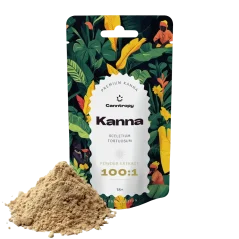
Canntropy Kanna (Sceletium Tortuosum) Powder Extract 100x, 5g - 100g
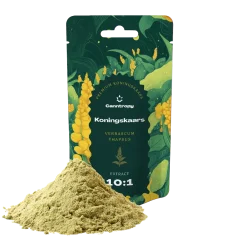
Canntropy Koningskaars (Verbascum thapsus) Extract 10:1, 5 g - 100 g