
 English (EUR)
 Česky (CZK)
 Deutsch (EUR)
 Austria (EUR)
 Polski (PLN)
 Français (EUR)
 Español (EUR)
 Italiano (EUR)
 Română (EUR)
 Ελληνικά (EUR)
 Dutch (EUR)
 Eesti keel (EUR)
 Português (EUR)
 Magyar (EUR)
 Svenska (EUR)
 Dansk (EUR)
 Suomen kieli (EUR)
 български език (EUR)
 Slovenščina (EUR)
 Slovensky (EUR)
 lietuvių kalba (EUR)
 latviešu valoda (EUR)
 Hrvatski (EUR)
 українська мова (EUR)
 Bahasa Indonesia (EUR)
Guide to HHCH: What it is, effects, production, risks and available products
- What is HHCH and how is it produced?
- Recreation or wilderness? Effects of HHCH
- Side effects and other risks
- Cannabinoid Terrarium: HHCH vs. HHCPO vs. THCPO vs. H4CBD Table
- Kiosk: What are the available HHCH products on the market?
- Conclusion
What is HHCH and how is it produced?
Has it come to your attention that HHCH is a brand new compound? Yes, it is on the cannabis market, but HHCH was first synthesised in 1942 by the famous American chemist Roger Adams, who was also the first to isolate pure CBD from the hemp plant. And what did he find in his scientific study? That HHCH is more potent than the pentyl and heptyl homologue or unsaturated analogue of THC (tetrahydrocannabinol).
HHCH stands for hexahydrocannabihexol, a semi-synthetic derivative that is exclusively produced in the laboratory. It is produced by a process called hydrogenation, specifically by the hydrogenation of a distillate of THCH (tetrahydrocannabishexol) and its transformation into HHCH. The resulting form of HHCH is a thick, high-viscosity oil. The molecular formula is C22H34O2.
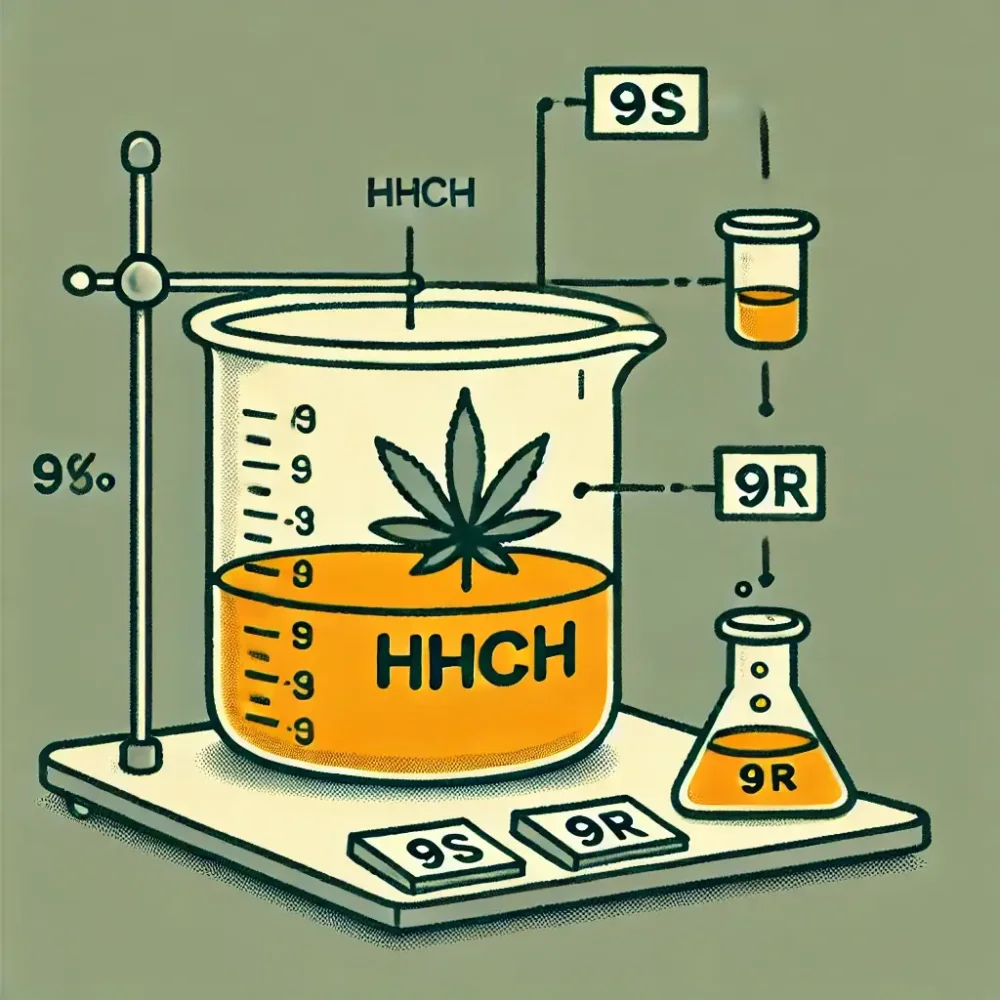
Incidentally, the hydrogenation process also produces the cannabinoids H4CBD and HHC. And since HHCH, like H4CBD and HHC, is a hydrogenated compound, it consists of 2 different stereoisomers, i.e. 9(R)-HHCH and 9(S)-HHCH molecules. Why are we talking about these molecules, you wonder? It's because they affect the potency and strength of the product.
The 9(R) molecule binds very efficiently to CB1 receptors in the endocannabinoid system (ECS) of the body, and this produces a psychoactive effect, whereas 9(S) acts as an inactive component. The ECS can be thought of as a complex intricate network that is responsible for several activities of the body (sleep, pain perception, mood, appetite, movement coordination and immunity).
A 2023 study on the cannabinoid HHC reported that the 9(R) molecule binds more effectively to CB1 receptors, which are found in the nervous system, in the brain, and CB2 receptors, which span the immune system, the digestive tract and other organs. The activity of the 9(R) isomer almost matches that of THC, while the 9(S) molecule shows reduced activity in functional tests.
Recreation or wilderness? Effects of HHCH
The main thing you're probably interested in, and why you set out to explore HHCH, is the effects. You already know that whether or not this cannabinoid is psychotropic or not is determined by its cooperation with the CB1 receptor in the ECS. Since Roger Adams indicated in his study that it is a potent substance, it can be assumed that hexahydrocannabidihexol exerts a significant psychoactive effect on the body.
It may come as a bit of a disappointment now, but at the moment we know about as much about the effects as we do about the okapi that have long hidden from the public in the rainforest.
HHCH is generally reported to have psychoactive effects comparable to THC. Compared to other cannabinoids, for example, HHC has a longer duration of action, the effects can last for 2-8 hours, and has slightly milder effects compared to HHCP. Some even report that it is about 10-15 times stronger than THC and that it slightly surpasses THCH in intensity. However, this information cannot yet be confirmed due to the lack of research.
The cannabinoid HHCH can affect perception, induce feelings of euphoria or relaxation and relieve symptoms of pain and inflammation, similar to other psychoactive cannabinoids such as THCJD, THCB, HHCPO and THCPO.
If you are a first-time visitor to a cannabis zoo, we recommend you start with CBD, CBG or CBN, or H4CBD and CBDP. HHCH is exclusively suited for experienced visitors, as it is a semi-synthetic cannabinoid that is generally agreed to be more potent than natural cannabinoids.
❌ Keep in mind that under no circumstances is it recommended to drive or operate any machinery after taking compounds of this type.
Safety alert: Side effects and other risks
In the cannabis zoo, (semi)synthetic compounds act like crocodiles, they can surprise even an experienced caregiver with a strong and dangerous grip on their jaws. As already mentioned, (semi)synthetic compounds are much more potent than natural cannabinoids, which multiplies the potential risk of intoxication and overdose, which can result in a situation called a "bad trip".
Some may experience unpleasant negative psychological effects such as anxiety, panic, paranoia and hallucinations.
Other possible side effects:
- Fatigue and drowsiness
- Increased heart rate
- Dry mouth
- Redness of the eyes
- Headaches
- Nausea (vomiting)
At this time, it cannot be excluded that other as yet undetected side effects may occur.
⚠️ Experts also point out that the purity and safety of synthetically produced products often cannot be proven. As a result, unknown substances such as residual solvents, unnatural isomers and other unrecognised compounds may be present in these products, making them potentially dangerous for human consumption.
Another problem is that legislation on cannabinoids is complex and sometimes opaque across countries, which complicates the evaluation of products, i.e. the real cannabinoid content and overall safety. In short, there is a lack of legislation to ensure quality, safety and legality.

If you decide to buy any cannabis product, always ask for a lab analysis, read the product ingredients and rely on verified cannabis companies.
And why is laboratory analysis important? Because a third-party lab report gives you objective data on product purity, safety and regulatory compliance (maximum THC limit). Verify that the product is free of unsuitable additives, toxins and fillers.
Terrarium of cannabinoids: HHCH vs. HHCPO vs. THCPO vs. H4CBD table
|
|
HHCH |
HHCPO |
H4CBD |
|
|
Natural vs. synthetic cannabinoid |
A semi-synthetic cannabinoid derivative, not found in cannabis. |
A semi-synthetic derivative of a cannabinoid not found in cannabis. |
A semi-synthetic cannabinoid not found in cannabis. |
A semi-synthetic cannabinoid, a derivative of CBD, not found in cannabis. |
|
Chemical structure modification |
Hydrogenation |
Hydrogenation and acylation |
Acylation |
Hydrogenation |
|
Psychoactive properties |
Yes |
Yes |
Yes |
Available |
|
Legal status |
It can be in a legal grey area, and is an illegal substance in the Czech Republic, Bulgaria, Croatia, Slovenia, Lithuania, Latvia, Hungary, the UK and Greece. |
It can be in a legal grey area, and is an illegal substance in the Czech Republic, Bulgaria, Lithuania and Latvia, for example. |
It can be in a legal grey area, and is an illegal substance in the Czech Republic, Austria and the UK, for example. |
It can be in a legal grey area, and is an illegal substance in Estonia, Denmark and Finland, for example. |
Kiosk: What are the available HHCH products on the market?
🛒 Despite the lack of clinical studies and the fact that it is not yet possible to say for sure that the use of HHCH is completely risk-free, these products are appearing on some foreign markets:
- HHCH distillate: added to other products such as liquids, resins or used to infuse the flowers of industrial hemp
- Oil: usually combines cannabinoid extract and carrier oil
- Extracts and concentrates
- Hash: cannabis concentrate made from industrial hemp pollen and HHCH distillate
- HHCH vapes, replacement cartridges and liquids
- HHCH flowers, which are sticks of technical cannabis infused with HHCH distillate
Commonly available HHCH products meet the legal standard of 0,2-0,3 % THC on dry weight basis.
Conclusion
Cannabis plants do not produce HHCH, it is a semi-synthetic derivative that is produced by hydrogenation of THCH distillate and its conversion to HHCH.
It is generally reported that HHCH has psychoactive effects comparable to THC. The potency and strength of the product is influenced by the ratio of the molecules, 9(R)-HHCH and 9(S)-HHCH. If 9(R) dominates the product, the product will be more potent.
And just as you don't go into a gorilla enclosure without thinking and being accompanied by an experienced caregiver, don't rush into using unknown substances, and if you want to try them, always rely on reputable companies that provide laboratory analysis of their products.
Author: Patricie Mikolášová
Photo: AI
"All information provided on this website, as well as information provided through this website, is for educational purposes only. None of the information contained herein is intended to be a substitute for a medical diagnosis and should not be considered medical advice or recommended treatment. This website does not endorse, condones or advocate the licit or illicit use of narcotic drugs or psychotropic substances or the commission of any other illegal activity. For more information, please see our Disclaimer ."